
FDA GMP Design Controls
Design Controls Under the FDA QMSR (ISO 13485:2016, Clause 7.3)
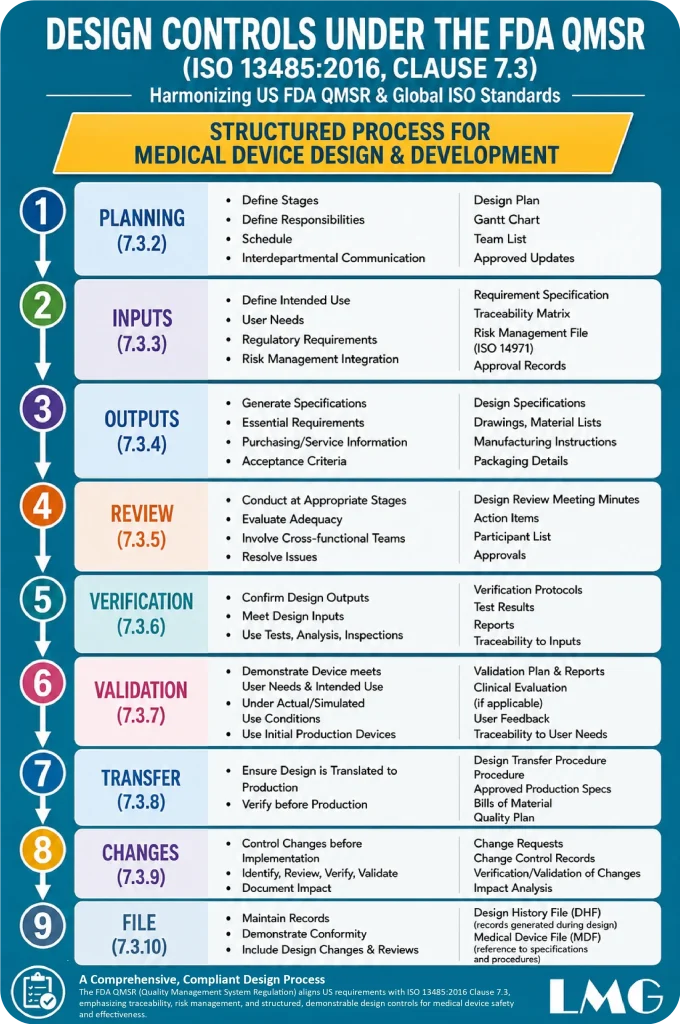
Design Controls Under the FDA QMSR (ISO 13485:2016, Clause 7.3)
The FDA’s medical device quality framework changed significantly on February 2, 2026, when the longstanding Quality System Regulation (QSR) gave way to the new Quality Management System Regulation (QMSR). Under the revised 21 CFR Part 820, design and development requirements — previously found in Subpart C (§820.30) — are now governed by ISO 13485:2016, Clause 7.3 (Design and Development), incorporated by reference through §820.10(c). Medical device manufacturers who commercially distribute finished devices in the U.S. must maintain design controls that comply with ISO 13485:2016, along with the additional FDA-specific requirements the QMSR layers on top.
Design and development controls remain a critical part of an effective quality management system. LMG provides expert QMS and CGMP consulting to help you build, document, and maintain a compliant design control process under the QMSR and ISO 13485:2016, including:
- Design and development planning
- Design input requirements
- Design output verification
- Design validation and review
- Design transfer and changes
LMG assists medical device manufacturers with QMSR and ISO 13485:2016 gap assessments, procedure and document development, design history file (DHF) and design control system support, and audit and inspection readiness — helping you transition from the legacy QSR and stay compliant under the new Quality Management System Regulation.
Frequently Asked Questions
Where are design control requirements found under the new QMSR?
Design controls are no longer in Subpart C (§820.30) of the old Quality System Regulation. Under the QMSR, effective February 2, 2026, design and development requirements are governed by ISO 13485:2016 Clause 7.3, which is incorporated into 21 CFR Part 820 by reference through §820.10(c). So the “21 CFR Part 820” citation still applies, but the substance now comes from ISO 13485.
Is the Design History File (DHF) still required under the QMSR?
The QMSR shifts to ISO 13485:2016 terminology, which uses the concept of a “design and development file” rather than the QSR’s “Design History File.” In practice, you still need to compile and maintain records demonstrating that your design was planned, that inputs and outputs were defined, and that verification, validation, review, transfer, and change control were carried out. Manufacturers transitioning from the QSR should update their procedures and terminology to align with ISO 13485, while keeping the underlying records intact.
We already comply with the old QSR design controls. How big is the transition?
For most manufacturers, the design control fundamentals — planning, inputs, outputs, verification, validation, review, transfer, and change control — carry over, since ISO 13485:2016 Clause 7.3 covers the same ground. The main work is aligning terminology, restructuring procedures to reference ISO 13485 instead of §820.30, and ensuring FDA-specific requirements layered on by the QMSR are addressed. Companies already certified to ISO 13485:2016 will generally have a smaller gap than those that complied only with the U.S. QSR.
Need FDA QMSR Consulting?
LMG provides expert 21 CFR Part 820 GMP and QMSR consulting for medical device manufacturers worldwide.
Start Registration Contact Us