
CAPA — Corrective & Preventive Action
under the QMSR and ISO 13485:2016.
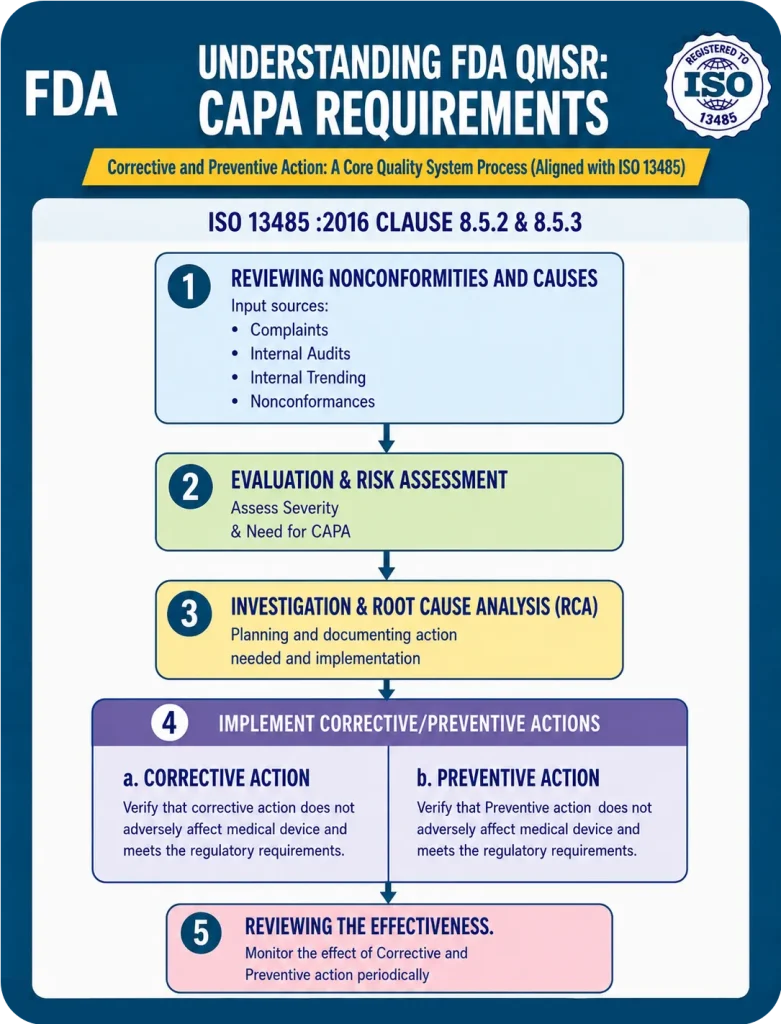
CAPA — Corrective and Preventive Action Under the FDA QMSR
As of February 2, 2026, the FDA’s Quality Management System Regulation (QMSR) replaced the former Quality System Regulation (QSR). The QMSR amends 21 CFR Part 820 by incorporating by reference ISO 13485:2016, the international quality management system standard for medical devices. This means medical device manufacturers who commercially distribute finished devices in the U.S. must now maintain a quality management system that complies with ISO 13485:2016, along with the additional FDA-specific requirements the QMSR layers on top.
An important point for manufacturers: QMSR is not identical to ISO 13485, and ISO 13485 certification alone does not exempt your facility from FDA inspection. The FDA retains full inspection authority and, as of February 2, 2026, transitioned from the legacy Quality System Inspection Technique (QSIT) to an updated inspection process. A compliant, inspection-ready QMS remains essential.
Corrective and Preventive Action (CAPA) continues to be a core element of an effective quality management system under the QMSR and ISO 13485:2016. LMG provides expert QMS and CGMP consulting to help you build, document, and maintain a compliant CAPA process, including:
- Systematic data analysis to identify quality problems and trends
- Root cause investigation procedures
- Corrective action implementation and verification
- Preventive action to reduce the likelihood of recurrence
- CAPA effectiveness review, documentation, and closure
LMG assists medical device manufacturers with QMSR and ISO 13485:2016 gap assessments, procedure and document development, CAPA system design, and audit and inspection readiness — helping you transition from the legacy QSR and stay compliant under the new Quality Management System Regulation.
Frequently Asked Questions
Is 21 CFR Part 820 still in effect, or was it replaced by the QMSR?
Part 820 is still in effect and still the correct citation — it wasn’t given a new number. What changed is its content and title. As of February 2, 2026, Part 820 is titled the Quality Management System Regulation (QMSR) and now incorporates ISO 13485:2016 by reference, replacing the older Quality System Regulation (QSR) framework. So you still cite “21 CFR Part 820,” but it now points to ISO 13485 plus FDA-specific requirements rather than the old subsystem structure.
Does ISO 13485:2016 certification mean I'm automatically FDA-compliant and exempt from inspection?
No. While ISO 13485:2016 compliance is now a regulatory requirement under the QMSR, the QMSR is not identical to ISO 13485 — the FDA adds its own requirements on top (for example, around recordkeeping, labeling, device identification, and reporting). ISO 13485 certification also does not exempt your facility from FDA inspection. The FDA retains full inspection authority and, as of February 2, 2026, replaced its legacy QSIT inspection approach with an updated inspection process.
How is CAPA affected by the transition from the QSR to the QMSR?
CAPA remains a core requirement, but it now flows from ISO 13485:2016’s clauses rather than the old standalone §820.100 subsystem. The fundamentals — data analysis to spot problems, root cause investigation, corrective and preventive actions, and effectiveness review and closure — still apply. The main shift is in terminology and structure, so manufacturers transitioning from the QSR should update their CAPA procedures and documentation to align with the QMSR and ISO 13485 language.
Need FDA QMSR Consulting?
LMG provides expert FDA QMSR consulting for medical device manufacturers worldwide.
Start Registration Contact Us